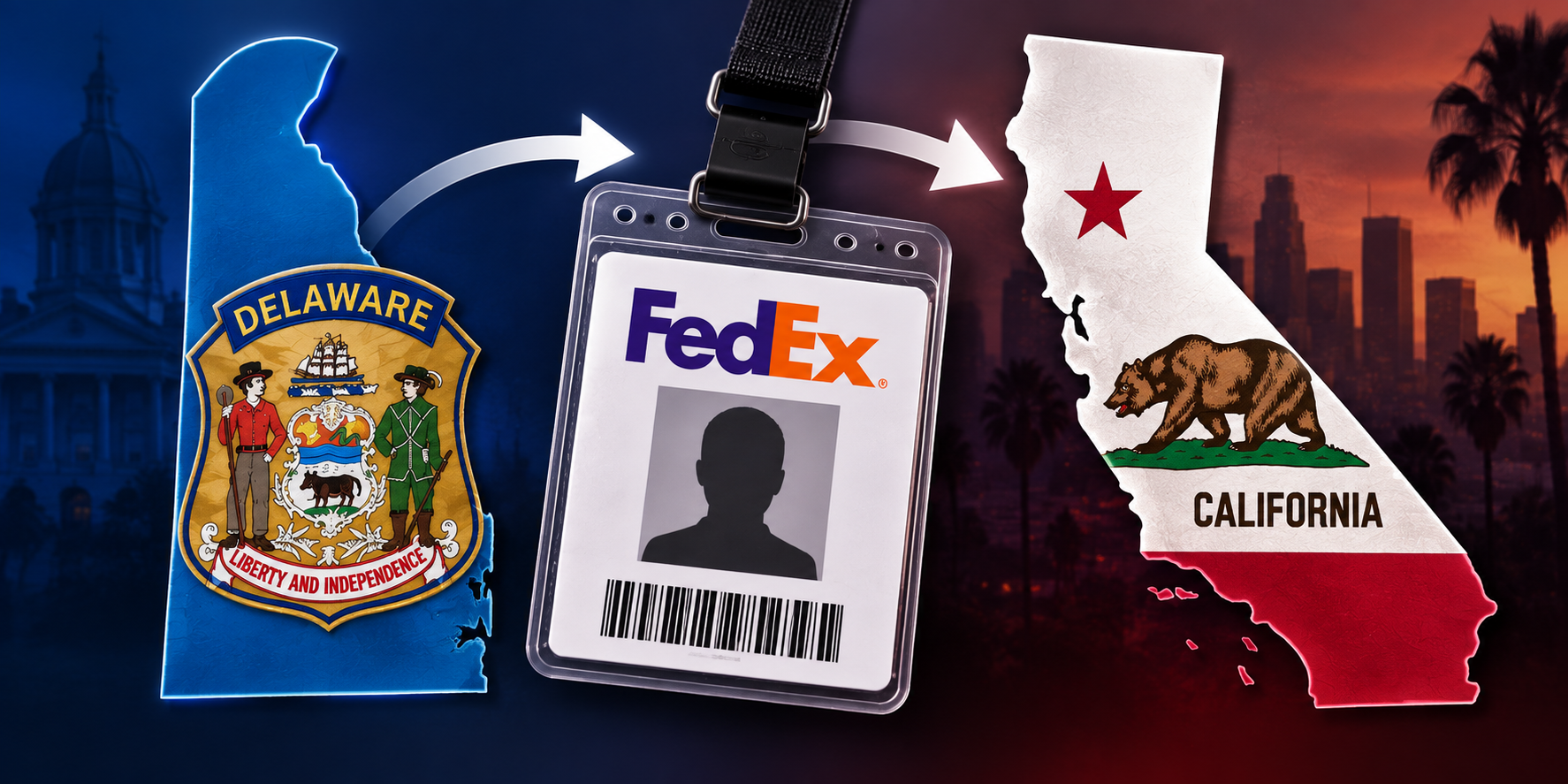
The cargo was recovered. One suspect is in custody. The method they used is up 31% year over year and it works because most warehouses still treat a document as proof of identity.
At 9:15 a.m. on September 14, 2026, two men pulled a tractor-trailer cab up to the dock at Emolo Consumer Electronics, 1146 River Road, New Castle, Delaware. According to the Delaware State Police, they told the warehouse employees they were FedEx drivers, handed over driver’s licenses and shipping documents for a loaded trailer, hooked the trailer to their cab, and drove away. The cargo inside was worth more than $680,000. Nobody stopped them. The documents looked right, the licenses looked right, and the story was plausible. That’s all it took.
This isn’t a story about a brazen heist. It’s a story about a verification gap that the freight industry has known about for years and still hasn’t closed. The industry term for what happened on River Road is a fictitious pickup: criminals impersonating a legitimate carrier or employee, using forged credentials to take physical possession of a load that was then theirs to do with as they pleased. The forgery is the key that turns the lock. Once the trailer is connected to the cab and rolling, the window to stop it closes fast.
According to the Delaware State Police release, the shipper didn’t learn the documents were fraudulent until later that same day. By then, the truck was already parked at University Plaza in Newark. That detail matters. These weren’t sophisticated enough to make the trailer disappear. They apparently had no offload point ready, no transfer scheme set up, no fence lined up for $680,000 in consumer electronics. What they had was a set of fake CDLs, a fake plate, and a story about FedEx, and that package was enough to walk out the front door of a warehouse in broad daylight. The dock workers had no reason to disbelieve them. That’s the architecture of the problem.
On September 15, the shipper called 911 after locating the parked rig. Delaware State Police troopers responded to University Plaza and, while speaking with the caller, observed a man walking toward the tractor-trailer. According to the state police release, the man was Dushatdaman Parihar, 35, of Manteca, California. Troopers contacted Parihar and determined that the driver’s licenses presented at the warehouse and the tractor-trailer’s registration plate were fraudulent. Troopers took him into custody without incident. State police recovered the trailer and all its contents and returned them to the business.
Parihar has been charged with felony theft of property valued at $100,000 or more, first-degree forgery, second-degree forgery, second-degree conspiracy, and displaying a fictitious registration plate, according to state police. A Justice of the Peace Court arraigned him, and he was committed to the Delaware Department of Correction on a $66,550 secured bond. He is presumed innocent unless proven guilty in a court of law. A second suspect remains unidentified and at large. The Delaware State Police Criminal Investigations Unit continues to investigate. Anyone with information is asked to contact Detective S. Marioni at (302) 365-8388 or Delaware Crime Stoppers at 1-800-847-3333.
Parihar is from Manteca, California. That geographic detail is worth noting, not because California proves anything about him, but because California is where the organized infrastructure for this kind of theft is most concentrated. According to Overhaul’s Q1 2026 Cargo Theft Report, nearly half of all deceptive pickup incidents nationwide occurred in California during the first quarter. The patterns the industry has documented in that state forged credentials, brand impersonation, staged pickups are the same patterns that appeared on a dock in Delaware on a Monday morning in September. The record doesn’t establish that this theft is connected to a larger network. It does establish that the method is not improvised. You don’t drive from California to Delaware with fake CDLs, a fake plate, and a story about FedEx without some preparation.
The numbers behind the method are not ambiguous. Deceptive pickup schemes, the category that covers fictitious pickups, carrier impersonation, and forged-credential theft, jumped 31% year over year in Q1 2026, according to Overhaul’s report. According to Verisk CargoNet data reported by Dark Reading, about a quarter of all cargo theft incidents in Q1 2026 fell into the cyber-enabled categories of fictitious pickup or fraud. Verisk recorded 158 fictitious pickup incidents in Q2 2026 alone, down only slightly from 165 in the same quarter a year earlier, even as overall theft-classified events fell from 488 to 378, according to Intellicheck’s analysis of CargoNet data. The declining theft methods are the ones that require brute force. The ones holding steady require beating an identity check.
The aggregate losses behind those incidents are large. According to Verisk CargoNet data reported by multiple industry outlets, estimated losses from supply chain crime surged to nearly $725 million in 2025, a 60% increase from 2024, with the average value per theft rising to $273,990. The $680,000 load in New Castle is more than twice that average. Electronics are among the most targeted freight categories, according to Overhaul, partly because they’re liquid: easy to move, easy to sell, and hard to trace once they’ve been broken out of their original packaging and pushed through secondary markets.
The mechanism the suspects used in Delaware is worth understanding precisely, because the industry’s standard defenses aren’t built to stop it. Most warehouse receiving operations verify a pickup by checking that a driver has a bill of lading or pickup order that matches what’s on the dock, and that the person holding the document has a CDL with a name on it. That process was built to prevent clerical errors and honest mix-ups. It wasn’t built to defeat a set of forged documents prepared specifically to match the shipment. If the forgery is good enough to pass a visual inspection — and in this case it apparently was — the standard dock procedure hands the load over and records the transaction as complete. The shipper’s own process becomes the exploit.
The fix isn’t complicated in concept, even if it takes operational changes to implement. Carrier identity verification at the dock means calling the carrier back using a phone number you looked up independently, not one printed on the document the driver handed you. It means confirming the pickup order number through your own TMS or directly with the shipper’s logistics contact, not by reading it off the bill of lading the driver produced. It means treating the document as a starting point for verification, not as the verification itself. A CDL is a laminated card. A bill of lading is a piece of paper. Neither of those is an identity check. The check is the callback. The check is the cross-reference. The check is the thirty seconds it takes to confirm the pickup through a channel the criminal can’t control.
What the record doesn’t establish is whether Emolo Consumer Electronics or any other party in this chain had contractual or regulatory obligations that were breached. That’s a question for the investigation and, if it gets there, for a court. What the record does establish is that two men with fake paper walked into a warehouse, told a story, and drove out with $680,000 in merchandise because the dock’s verification process ended at the document. That’s not a flaw in any one company’s procedure. It’s a structural feature of how most freight pickups are verified in the United States, and the people who run fictitious pickup schemes know it.
